


Most fashion markdowns are decided before the season starts, in what a retailer buys and how it allocates it. Markdown bleed, the steady margin loss from over-discounting, is the symptom. The cause is stock bought without real demand data and sent to the wrong stores. Retailers reduce it by fixing those upstream decisions first, then by seeing stock in real time, pricing by location rather than by calendar, and moving stock across channels before they discount it.
The core problem: Markdown bleed is not a pricing problem. It is a buying and allocation problem that shows up at the till.
What causes markdown bleed?
Markdown bleed is the steady margin a retailer loses to repeated, reactive discounting of stock it bought or placed wrong. Research confirms the scale of the problem: inventory misjudgments, including overbuying, buying the wrong type of products, and misallocating stock, account for 53% of unplanned markdown costs for retailers, according to the Coresight Research and Celect report "Revealing the Hidden Costs of Poor Inventory Management." The same study found that only 60% of US apparel retail sales are made at full price, with markdowns costing nongrocery retailers an estimated $300 billion in lost revenues annually.
The mechanism is straightforward. When a retailer buys to a plan that is not grounded in demand, or allocates the same assortment to stores that sell differently, some stores run out of what sells and others sit on what does not. The stock that does not move gets marked down, again and again, on a calendar rather than on evidence.
Three things reactive discounting does to your business
Reactive, calendar-based discounting creates a compounding problem beyond the immediate margin loss:
· It erodes gross margin. Each unplanned markdown reduces the return on the original buy. Across a season, the cumulative effect is significant.
· It trains customers to wait for the sale. Shoppers in stores that discount predictably learn not to buy at full price. The discount becomes the expected price.
· It distorts the next season's plan. Sell-through data from a heavily discounted season is noise, not signal. Planning the next buy on corrupted data repeats the cycle.
The discount is where the loss lands. The decision that caused it happened months earlier, in the buying room.
How do you reduce markdowns caused by poor buying and allocation?
You fix the decisions upstream of the discount, and you give yourself the visibility to act before stock goes stale. Five things do most of the work.
1. Buy and allocate to real demand
Plan buys against actual sell-through by store and by attribute, not against last year plus a percentage. Allocate to how each store actually sells rather than to an even spread. Most markdown bleed is bought in before the season opens, so this is where the largest saving sits. Overbuying alone accounts for approximately 30% of all markdowns, according to the Coresight-Celect data, making it the single biggest lever available to a buying team.
2. See your stock in real time
A single stock ledger, built on clean product data down to size, color, and style, tells you what you hold and how it is selling while you can still act on it. You cannot reallocate or hold a markdown on stock you cannot see accurately. Retailers running siloed or batch-updated systems are effectively making decisions on data that is already stale.
3. Price and mark down by location, not by calendar
A style selling through in one region and stalling in another does not need the same markdown in both. Localized, evidence-based pricing protects margin where demand is healthy and clears stock only where it genuinely needs clearing. Calendar-based markdowns apply the same discount to stores with different demand profiles, which means you are giving away margin in stores where you did not need to.
4. Move stock before you mark it down
Full-price demand for a slow style often exists in another store or online. Omnichannel fulfillment, drawing on one view of inventory, lets you sell it at full price somewhere else before the discount becomes the only option. This is one of the clearest margin recovery opportunities available to a multi-store retailer, and it depends entirely on having a single, accurate inventory record across channels.
5. Fix problems upstream with suppliers
Late or wrong deliveries force clearance later. Tighter supplier collaboration on timing, quantities, and accuracy stops the problems that end in a markdown from entering the season in the first place. When a delivery arrives two weeks late, the selling window shrinks and the markdown becomes more likely, not because of a bad buy, but because of a bad delivery.
Key takeaway: The five strategies above are not independent. They all depend on the same underlying capability: a clean, real-time record of what you hold, where it is, and how it is selling.
Where does a merchandise management system fit?
A merchandise management system is what makes those five strategies possible in one place, because they all depend on the same clean, real-time record of stock, buying, and pricing.
Without that record, the five strategies above remain aspirational. A buying team working from spreadsheets or a system that updates overnight cannot act on intraday sell-through signals. A store network without a single inventory view cannot reallocate stock before it stalls. A pricing team without localized demand data cannot make evidence-based markdown decisions by location.
What Island Pacific SmartSuite provides
Island Pacific's merchandise management system is built specifically for fashion, apparel, footwear, and specialty retailers. It holds the record that makes markdown control possible:
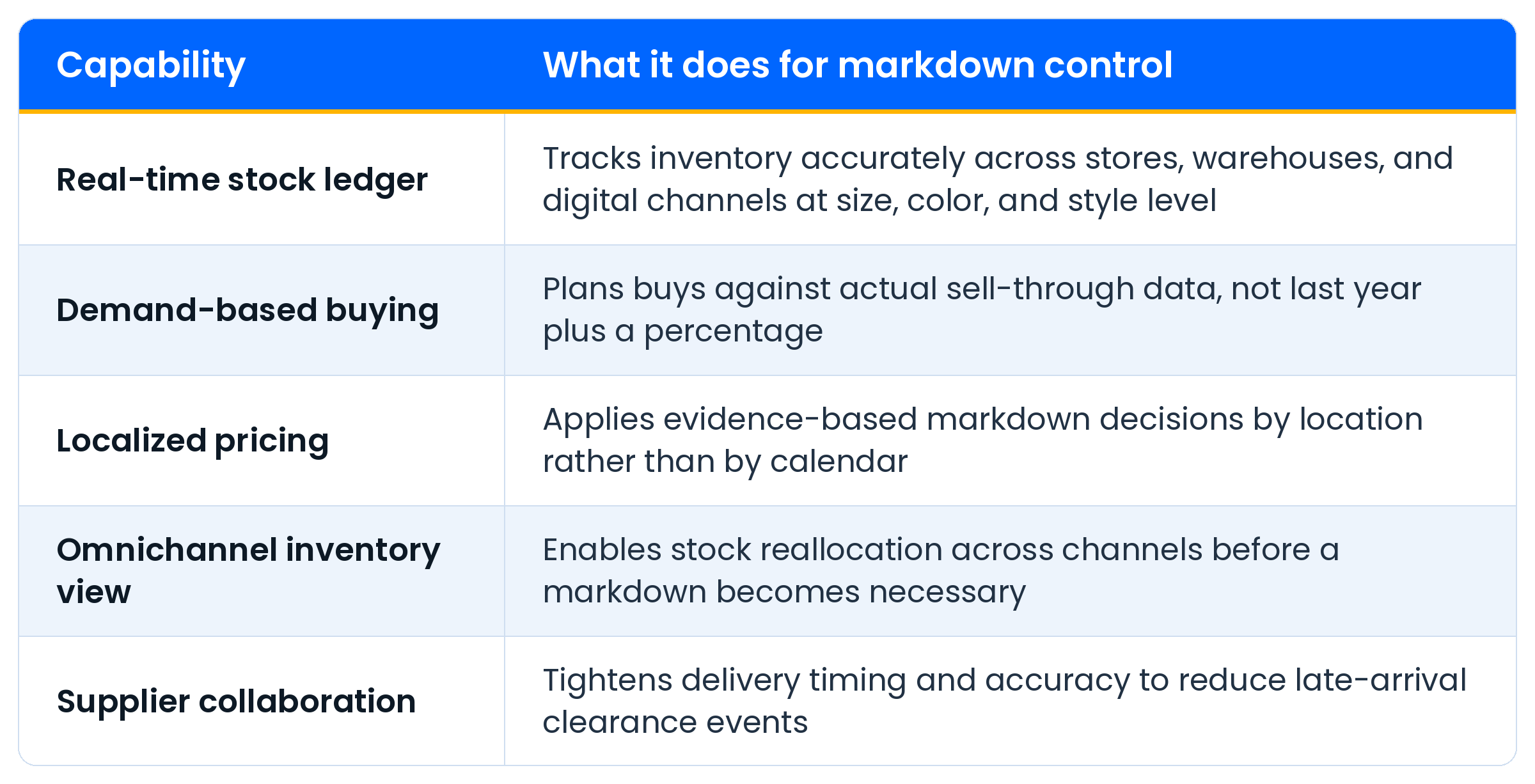
The result is that markdowns become a lever you choose to pull, not a loss you absorb. When the decision to discount is based on real demand data, by store and by attribute, it protects margin where demand is healthy and clears stock only where it genuinely needs clearing.
For retailers evaluating whether their current system is equipped to do this, the question is not whether it tracks inventory. It is whether it tracks inventory accurately enough, in real time, across every channel, to act before stock goes stale. If clearance is where you find out what went wrong, the problem is upstream.
The merchandise planning capability inside SmartSuite addresses that upstream decision-making directly, connecting the buy to real demand data before the season opens.
Is your system protecting your margin, or feeding the bleed?
If clearance is where you find out what went wrong, the problem is upstream. The buying decision, the allocation, the inventory record that was not accurate enough to act on in time. A merchandise management system built for fashion and apparel gives you the visibility to catch those problems before they become markdowns.
Book a demo and we'll show you where your margin is leaking, and what one connected record does about it.